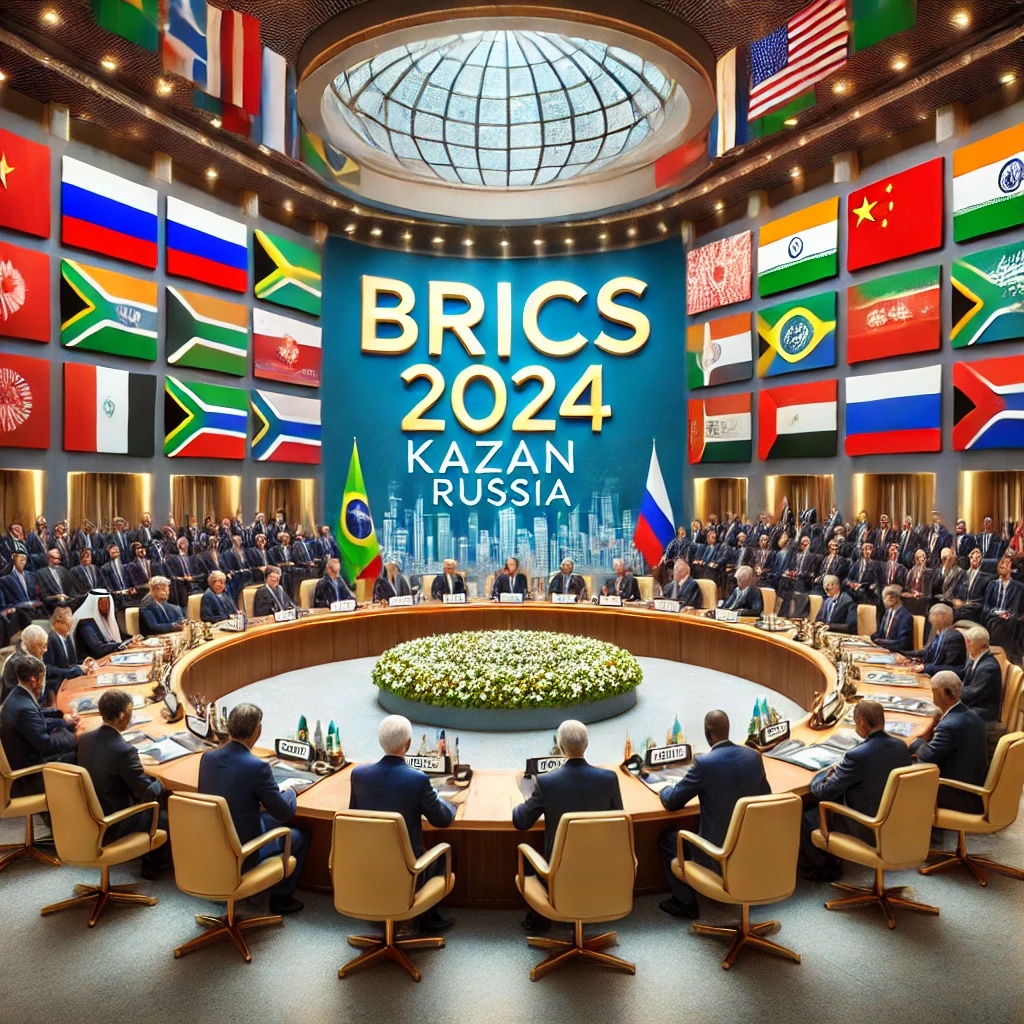
BRICS Summit 2024: A New Era of Global Cooperation

25-October-2024

The 16th BRICS Summit, held from October 22-24, 2024, in Kazan, Russia, brought together leaders from Brazil, Russia, India, China, and South Africa. With an overarching theme of “Fostering Multilateralism and Reforming Global Governance,” the summit underscored the bloc’s dedication to reshaping the global economic and political landscape, positioning itself as a prominent counterbalance to Western-dominated institutions. This summit proved historic, not only for its strategic declarations but also for welcoming five new members—Saudi Arabia, UAE, Egypt, Iran, and Ethiopia—signaling BRICS’ commitment to inclusivity and expanding its influence across diverse regions .

Key Outcomes and the Kazan Declaration

The summit’s concluding document, the “Kazan Declaration,” outlined BRICS’ unified stance on global issues. Here are some critical takeaways:

1. Strengthening Economic Ties: In a bid to reduce dependence on the U.S. dollar, the bloc agreed to increase trade in local currencies and introduced frameworks such as the BRICS Grain Exchange and a Cross-Border Payment System. These initiatives aim to bolster economic resilience and empower developing nations with a more balanced financial architecture .

2. Geopolitical Stance: BRICS took a clear position on global conflicts, advocating for peaceful solutions, particularly in Ukraine and Palestine. The leaders highlighted the importance of diplomacy and conflict de-escalation, emphasizing the humanitarian consequences of unresolved conflicts .

3. Sustainable Development Goals: The declaration also emphasized BRICS’ commitment to sustainable development, addressing environmental issues and healthcare. This includes collaboration on initiatives like India’s Big Cats Alliance for wildlife conservation and joint efforts to combat antimicrobial resistance, indicating a multifaceted approach to global challenges .

4. Innovation and Finance: The BRICS Interbank Cooperation Mechanism was introduced to streamline cross-border financial exchanges, alongside efforts to promote new technologies and practices in finance. These moves underscore BRICS’ focus on developing a multipolar world order that encourages self-reliant and interconnected economies .

5. The BRICS Plus Partnership: This year, BRICS established the “BRICS Partner Country” category, officially inviting countries like Egypt, Saudi Arabia, and Iran. The BRICS Plus framework aims to increase collaboration on trade, development, and technological exchange, showing a shift toward a more inclusive model .

The Significance of New Membership

The inclusion of Saudi Arabia, UAE, Egypt, Iran, and Ethiopia marks a milestone in BRICS’ evolution. Each of these countries brings strategic advantages, from Saudi Arabia’s energy resources to Iran’s geopolitical leverage in the Middle East. Expanding BRICS membership not only diversifies the bloc but also positions it as a leading force in energy and geopolitical affairs, which is particularly relevant amid ongoing shifts in global power dynamics .

Conclusion

The 2024 BRICS Summit in Kazan has undeniably set the stage for a new phase of global cooperation. As BRICS works to foster a fairer, multipolar world order, it has demonstrated its commitment to providing alternative frameworks for economic and political cooperation. With these landmark decisions, BRICS is signaling its growing influence on the global stage, presenting itself as a pivotal force in a rapidly changing world.

This summit will likely have lasting impacts, not only for the member states but also for the broader international community that may look to BRICS as a model for cooperative, inclusive development.

#diplomacy_files

diplomacyfiles@gmail.com

India-Canada Diplomatic Tensions: What’s Behind the Recent Rift?

16-October-2024

Diplomatic relations between India and Canada have taken a sharp downturn in recent months, sparking widespread discussions across the international community. What started as allegations surrounding a murder case has escalated into a diplomatic face-off that could reshape ties between these two Commonwealth nations. Here’s an overview of the situation and what might lie ahead for India-Canada relations.

The Flashpoint: The Murder of Hardeep Singh Nijjar

The spark for the current tension can be traced back to June 2023, when Hardeep Singh Nijjar, a prominent Sikh leader in Canada and a vocal advocate for the Khalistan movement, was shot dead in Surrey, British Columbia. Nijjar’s death attracted attention not only because of his political activities but also due to his ties to India. For years, India has considered Nijjar a wanted terrorist, accusing him of organizing violent activities to push for a separate Khalistan state in the Indian state of Punjab.

On September 18, 2023, Canadian Prime Minister Justin Trudeau publicly accused the Indian government of being involved in Nijjar’s killing. Trudeau cited “credible allegations” suggesting the involvement of Indian intelligence agents in orchestrating the assassination on Canadian soil. This assertion sent shockwaves through diplomatic circles, as no direct accusations of this nature had been made by one democracy against another in recent years.

India’s Response: Rejection and Retaliation

India’s response to Trudeau’s accusations was swift and categorical. The Indian government rejected the claims as “absurd” and accused Canada of harboring extremist elements who support the separatist Khalistan movement. The Indian Ministry of External Affairs countered by pointing to Canada’s leniency toward Sikh extremists as the root cause of tensions, reiterating that Canada has failed to take action against individuals pushing for violence in India.

As diplomatic tensions deepened, both countries took retaliatory steps. India expelled a Canadian diplomat, and Canada followed by expelling an Indian diplomat. Travel advisories were issued, and the diplomatic back-and-forth created a chill in what was once a relatively warm bilateral relationship.

The Khalistan Movement: A Historical Context

To understand the depth of the tension, it’s crucial to grasp the broader context of the Khalistan movement. The movement began in the 1980s with demands for a separate Sikh state in Punjab, fueled by grievances against the Indian government. Violent clashes, bombings, and political assassinations marked the movement’s heyday, leading to a military crackdown by the Indian state, most notably the 1984 Operation Blue Star in the Golden Temple, Amritsar.

Though the movement has largely fizzled out within India, its support base has found a stronghold among Sikh diaspora communities, particularly in countries like Canada, the U.K., and the U.S. India has long accused Canada of turning a blind eye to Sikh extremism, pointing out that groups advocating for Khalistan still openly operate there. Trudeau’s Liberal Party has also been accused of pandering to this voter base, making the issue a consistent irritant in India-Canada relations.

Diplomatic Fallout: Broader Implications

Beyond the immediate back-and-forth, the current rift could have broader implications for international diplomacy and trade. Canada is home to a sizable Indian diaspora, and bilateral trade relations between the two nations have been on an upward trajectory. India is one of Canada’s largest trading partners in Asia, with trade reaching over $10 billion annually.

However, political tensions could stymie future cooperation. India has already suspended visa services for Canadian citizens, and Canada has reduced its diplomatic presence in India, citing concerns for the safety of its personnel. If this diplomatic freeze persists, it may also affect ongoing negotiations, such as the Canada-India Comprehensive Economic Partnership Agreement (CEPA), which both nations have been working toward for years.

What Comes Next?

As of now, the situation remains fluid. Canada’s demands for a thorough investigation into Nijjar’s murder and India’s insistence that Canada clamp down on extremist elements within its borders seem to be at odds with each other. Diplomatic mediators may step in to calm tensions, but for now, both nations appear entrenched in their respective positions.

While the future of India-Canada relations is uncertain, the current episode highlights the delicate balancing act that nations must navigate when handling domestic and diaspora politics. The risk of further escalation remains, but so too does the possibility for de-escalation if both sides can find common ground to address the underlying issues.

Conclusion

The diplomatic spat between India and Canada underscores the complex web of international relations, where domestic politics, diaspora influence, and historical grievances collide. Moving forward, both countries will need to assess how much they are willing to let the Khalistan issue affect broader areas of cooperation and diplomacy. The international community will be watching closely as this story unfolds, with far-reaching implications for global diplomacy.

Sources:

• Trudeau’s Allegations of India’s Involvement in Nijjar’s Death

• India’s Response and Diplomatic Retaliation

• Historical Context of the Khalistan Movement

• Implications for India-Canada Relations and Future Diplomacy

diplomacyfiles@gmail.com

The Escalating Tensions Between Israel and Iran: A Critical Overview

12-October-2024

The ongoing tension between Israel and Iran, rooted in decades of geopolitical rivalry, has taken new and dangerous turns in recent years. Both countries have been engaged in a shadow conflict, but recent events signal the possibility of escalation into direct confrontation. This blog will outline the key factors contributing to the conflict, analyze recent developments, and explore the broader implications for regional and global stability.

Historical Background

Israel and Iran were once allies, especially during the reign of the Shah of Iran. However, since the 1979 Iranian Revolution, the two countries have become bitter adversaries. The core of their enmity lies in ideological and geopolitical differences. Iran, under the Islamic Republic, views Israel as illegitimate and a Western foothold in the Middle East. In contrast, Israel sees Iran’s nuclear ambitions and support for militant groups like Hezbollah as existential threats.

The Nuclear Standoff

The most significant point of contention is Iran’s nuclear program. Israel views Iran’s potential to develop nuclear weapons as a direct threat, vowing to prevent Tehran from acquiring such capability by any means necessary. Iran maintains that its nuclear program is for peaceful purposes, but Israel, along with many in the international community, remains unconvinced.

In recent years, Israel has reportedly conducted covert operations, including cyberattacks and targeted assassinations, aimed at delaying or dismantling Iran’s nuclear progress. The most notable operation was the assassination of Mohsen Fakhrizadeh, a top Iranian nuclear scientist, in 2020, widely attributed to Israel.

Recent Developments in 2023-2024

While the nuclear issue remains central, recent developments in 2023 and 2024 have expanded the conflict into other arenas, increasing the risk of broader confrontation.

1. Hezbollah and Proxy Warfare: Iran’s support for Hezbollah, a Shiite militant group based in Lebanon, is a significant part of the conflict. Hezbollah is seen as Iran’s most effective tool against Israel, with thousands of rockets aimed at Israeli cities. In recent months, there have been increased clashes between Israeli forces and Hezbollah fighters along Israel’s northern border. Israel has conducted airstrikes in Syria, where Iran has a strong military presence, targeting Hezbollah convoys and Iranian arms shipments.

2. Drone Attacks: Both Israel and Iran have invested heavily in drone warfare. Iran has supplied drones to Hezbollah, the Houthis in Yemen, and other regional allies, while Israel has developed advanced counter-drone technology. In 2024, Israel accused Iran of attempting to attack sensitive sites in Israel using drones, heightening tensions.

3. The Abraham Accords Impact: The normalization of relations between Israel and several Arab nations, including the UAE and Bahrain, has further complicated Israel-Iran relations. Iran sees these alliances as an encirclement strategy aimed at isolating it. The Abraham Accords have strengthened Israel’s position in the region, particularly with Gulf states that are also wary of Iran’s influence.

Broader Regional Implications

The Israel-Iran conflict is not happening in a vacuum. It has broader implications for the Middle East and beyond.

1. The U.S. Role: The United States, historically a close ally of Israel, plays a pivotal role in this conflict. Under the Biden administration, the U.S. attempted to revive the 2015 nuclear deal, formally known as the Joint Comprehensive Plan of Action (JCPOA), which Israel opposes. While those talks have largely stalled, the U.S. continues to support Israel’s right to defend itself, supplying it with advanced military technology.

2. Russia and China’s Interests: Russia and China, both growing powers in the region, have their own interests. Russia, aligned with Iran in the Syrian civil war, has tried to maintain a delicate balance between its ties with Tehran and its coordination with Israel. China, which has strong economic ties to Iran, is also emerging as a player, particularly through its Belt and Road Initiative, which seeks to integrate Iran more deeply into global trade networks.

3. Energy Security: The Israel-Iran conflict has the potential to disrupt global energy markets. Both nations are key players in a region that supplies a significant portion of the world’s oil. A major conflict could lead to the closure of key maritime chokepoints like the Strait of Hormuz, through which a large percentage of global oil shipments pass, leading to skyrocketing prices.

The Prospect for Peace or Escalation?

Despite these rising tensions, there is still hope for diplomacy. While both Israel and Iran have shown a willingness to engage in covert and proxy warfare, neither has demonstrated an appetite for direct conflict. However, as incidents continue to pile up, the risk of miscalculation grows.

The path to de-escalation likely lies in multilateral diplomacy involving major powers like the U.S., Russia, and China. However, as long as fundamental issues like Iran’s nuclear ambitions and Israel’s security concerns remain unresolved, the conflict will continue to simmer, with the potential for a flashpoint always present.

Conclusion

The Israel-Iran conflict remains one of the most complex and dangerous rivalries in the world today. While direct war has been avoided so far, the current trajectory suggests that the risk of broader confrontation is increasing. The international community must remain vigilant, as any escalation could have severe consequences, not just for the region, but for global stability as a whole.

diplomacyfiles@gmail.com